Is my Tree Dangerous? Signs to Look Out For
Trees are an important part of our gardens, parks and landscapes. They provide shade, privacy, wildlife habitat and can add significant value to a property. However, like any living organism, trees can develop problems that may make them unsafe.
A dangerous tree does not always look obviously unhealthy. In some cases, a tree can appear perfectly normal while hidden defects weaken its structure. Understanding the warning signs can help you identify potential issues before they become a serious risk.
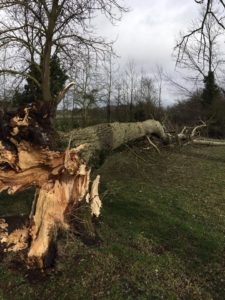
What makes a tree dangerous?
A tree may be considered dangerous when it has a higher likelihood of failure and could cause injury or damage if it falls or loses branches.
The level of risk depends on several factors, including:
- The condition of the tree
- The size of the tree or branches
- The likelihood of failure
- Nearby targets such as buildings, vehicles, roads or footpaths
- Weather conditions and exposure to strong winds
Not every defect means a tree is dangerous, but certain signs should never be ignored.
Common signs that a tree may be dangerous
Dead or dying branches
One of the most obvious warning signs is the presence of dead branches, particularly large limbs high in the canopy.
Dead wood can become brittle and may fall without warning, especially during windy weather. If you notice branches with no leaves during the growing season, peeling bark, or limbs that appear dry and lifeless, it may be time for a professional inspection.
Cracks in the trunk or major limbs
Visible cracks can indicate structural weakness within the tree.
While some cracks are superficial, others may extend deep into the wood and affect the tree’s ability to support its own weight. Large splits or cracks should always be assessed by a qualified arborist.
Fungal growth
The presence of fungi on or around a tree can sometimes indicate internal decay.
Common examples include bracket fungi growing from the trunk or large roots. These fungi may suggest that parts of the tree are rotting internally, potentially reducing its structural strength.
Not all fungal growth is a cause for alarm, but it is worth seeking professional advice if you notice mushrooms or brackets appearing on a tree.
Leaning trees
Many trees naturally grow at an angle and remain perfectly stable for decades.
However, a tree that has recently started leaning, or one that appears to be lifting soil around its base, may indicate root failure or instability.
Sudden changes in a tree’s position should be investigated as soon as possible.
Cavities and hollow areas
Hollows can provide valuable habitat for wildlife, but they can also reduce the structural integrity of a tree.
The significance depends on the size and location of the cavity, as well as the amount of sound wood remaining. A professional assessment can determine whether the tree remains safe to retain.
Decay around the base
The root system is essential for keeping a tree stable.
Signs of decay around the base of the trunk, exposed roots, or areas of soft, crumbling wood may indicate a loss of structural support. Problems below ground often go unnoticed until more obvious symptoms appear.
Excessive dead leaves or sparse growth
If a tree shows poor leaf coverage, unusually small leaves, premature leaf drop, or significant dieback in the canopy, it may be under stress or suffering from disease.
While these symptoms do not automatically make a tree dangerous, they can indicate underlying health issues that warrant investigation.
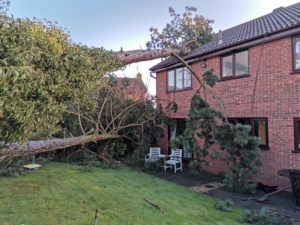
Storm damage and tree safety
Following strong winds or storms, it is advisable to inspect trees for:
- Broken or hanging branches
- Fresh cracks in the trunk
- Leaning stems
- Damaged roots
- Split branch unions
Some damage may not be immediately visible from the ground, which is why a professional assessment is often recommended after severe weather.
Can I assess a tree myself?
Property owners can carry out basic visual checks, but many structural defects are not obvious without specialist knowledge and equipment.
Factors such as internal decay, root problems and hidden weaknesses often require a trained arborist to identify accurately.
If you are unsure about the condition of a tree, it is always better to seek professional advice rather than wait until a problem develops.
When should I contact a tree surgeon?
You should consider arranging an inspection if:
- Large branches have died or fallen
- The tree has developed a noticeable lean
- You can see significant cracks or cavities
- Fungi are growing on the trunk or around the base
- The tree is close to buildings, roads or public areas
- You have concerns following a storm
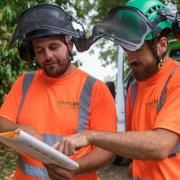
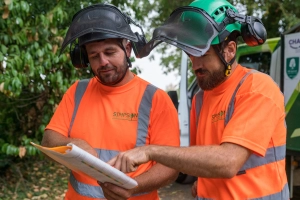
A qualified arborist such as our team at Simpson Arboriculture can assess the condition of the tree, identify any risks and recommend the most appropriate course of action, whether that involves monitoring, pruning, bracing or, in some cases, removal.
Final thoughts
Most trees are far safer than people assume and provide enormous benefits to our environment and properties. However, like any living structure, they can develop defects over time.
Regular inspections and early intervention can help prevent problems, protect people and property, and often allow valuable trees to be retained safely for many years to come.
If you are concerned about the condition of a tree on your property, seeking professional advice can provide peace of mind and help you make an informed decision. At Simpson Arboriculture, we offer free quotations. To arrange your quote, you can get in touch with us via our website.