
Crane-assisted removal of two large dead elm trees
Recently, we were appointed by a local council to remove two extra-large dead elm trees from Spanby churchyard. Both trees had deteriorated significantly and posed a risk of failure, making their removal essential for public safety.
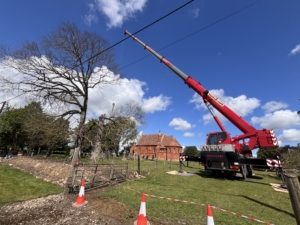
Before any work began, one of our experienced managers carried out a detailed site visit to assess the trees and plan the safest and most efficient method of removal.
Due to the size, condition and location of the trees, we decided that the majority of the dismantling would be carried out using a crane. This would allow large sections of the trees to be lifted away in a controlled manner, reducing the need for free-falling timber. It also helped in protecting the graves and surrounding features in the churchyard.
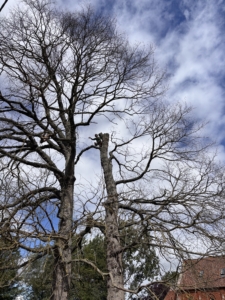
Dead timber can pose challenges due to its brittle branches, unpredictable features and reduced structural integrity, meaning there is an even greater need for a mechanised approach. We assessed this carefully prior to starting the work, and highlights the need for specialist expertise.
The climbing arborists worked using a two-rope climbing system. This consists of two independent anchor points while climbing, providing an additional level of safety when working at height.
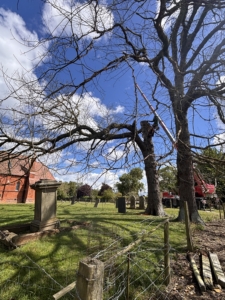
Access to the site presented another challenge. With limited space within the churchyard itself, the crane was positioned in a neighbouring field. Access was arranged in advance through the landowner. This allowed the crane to operate safely while still reaching both trees. The landowner wrote us a fantastic five-star Google review on completion of the work:
On the day, the team consisted of two experienced climbing arborists, a machine operator and a lorry driver, all working together to ensure the operation ran smoothly.
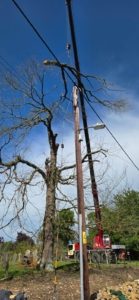
One of the climbers first ascended into the tree and began removing the branches in carefully planned sections. At nearly 20 metres in height, with a stem diameter of over 600mm, this was no mean feat! The team attached each section to the crane using lifting slings before they were cut free and carefully lowered to the ground. Throughout the dismantling process, clear communication between the climber and crane operator was essential, so the team used Stihl Comms headsets to coordinate every lift safely and efficiently.
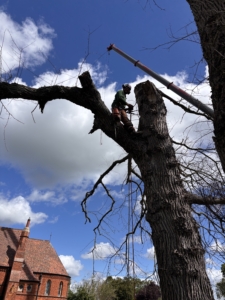
This approach proved particularly effective because of the number of obstacles surrounding the trees. Grave stones, boundary fencing and overhead power lines all had to be carefully avoided. The proximity of the public highway also meant the team needed to remain aware of passing pedestrians and vehicles throughout the day. Before work began, cones, the team installed warning signs and barrier tape to clearly define the work area and exclusion zone.
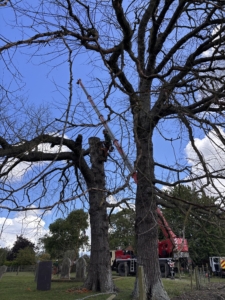
Once both trees had been dismantled, the team turned their attention to clearing the site. The local council had requested that all timber and arisings be removed.
Brash and smaller branches were processed through our large woodchipper, with the resulting woodchip later recycled to fuel our biomass boiler. Larger timber was moved using the crane, allowing it to be stacked neatly before being loaded onto our tractor and trailer for removal from site.
As the elm trees were dead, all chainsaws were thoroughly cleaned and sterilised afterwards as part of our biosecurity procedures, helping to prevent the potential spread of tree diseases between sites.
This was a technically challenging project that required detailed planning, specialist equipment and close teamwork throughout. While many tree removals can be completed using traditional climbing and rigging techniques, some projects demand additional planning and specialist machinery.
Our experienced team at Simpson Arboriculture has the knowledge and equipment to safely manage complex dismantles in sensitive locations, whether that’s around buildings, highways, churches or utilities.
If you’re interested in finding out more about what we can do, you can get in touch via our website. Our team would be happy to discuss your needs and arrange for a free site visit and quotation.